rss feed | youtube | links | the burning log
Friday, October 22, 2010And now a random Matt Groening factoid
"Cartoonist Matt Groening's two TV series are laced with references to John Bender, the teen rebel portrayed by Judd Nelson in The Breakfast Club, one of Groening's favorite movies. The hard-drinking, sarcastic robot Bender on Futurama was named for him; school bully Nelson Muntz on The Simpsons was named after Judd Nelson; and Bart Simpson's catchphrase, "eat my shorts," was first uttered by John Bender."
This random factoid was brought to you by Uncle John's Heavy Duty Bathroom Reader, due out in bookstores on November 1st.
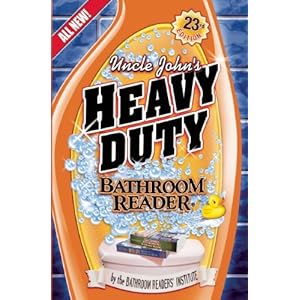 Why am I promoting the Uncle John's series? Uh, no reason. Nothing more to see here. *ahem* Yes, indeed, enjoy the entire series of Uncle John's tomes, available online at Amazon and wherever fine, bathroom-themed trivia books are sold. Labels: books Sunday, October 17, 2010Weird Oregon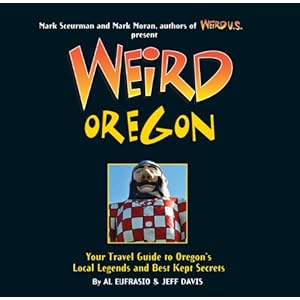 This fine tome can be found at Powell's and various gift shops around town. The layout is gorgeous, the content is informative and, yeah, something I wrote about the Forest Park "Witch House" can be found on page 15. C'mon, you know this thing would look a lot better sitting on your coffee table than that 3 year-old issue of The New Yorker (that's obscuring all those back issues of Maxim. You're not fooling anybody). Labels: books Tuesday, May 19, 2009The not-so simple life I picked up a copy of My Abandonment from Annie Blooms Books a few weeks ago. It's a fictionalized take on Frank and Ruth, a father and daughter who were discovered living in an elaborate homestead in Forest Park a few years ago. They were the subject of plenty of local media scrutiny and the two later disappeared after attempts were made to usher them back into society. Frank and Ruth left behind a relief fund, plenty of unanswered questions and no one seems to know what happened to them. Author Peter Rock's novel is devoted to theorizing what life must have been like for Ruth, dubbed here as Caroline, and the motives that fueled her father's desire to keep her almost entirely hidden from civilization. The first act of My Abandonment focuses on his attempts to educate and provide for his daughter while ducking authorities and the various miscreants that reside in the park. After they're discovered and relocated to a small town farm, Rock makes an educated guess about the family's fate as they drift through the dark corners of Portland and the rest of the state. In tone and spirit, My Abandonment shares a few similarities with The Road, Cormac McCarthy's post-apocalyptic ode to a father's indomitable love for his offspring. Rather than fleeing cannibals and an encroaching nuclear winter, Rock's protagonists devote their lives to running from predominantly imagined threats. Like The Road, the novel is equal parts disturbing and heartbreaking. The fact that it's based on a true story makes it all the more haunting. Labels: books Wednesday, April 01, 2009Frank and Ruth Forest Park is rife with tales of crime, tragedy and other assorted weirdness. There's at least three variations on the legend surrounding the "witch house" alone and, over the years, the park has played host to murderers, transients, drug addicts, pervs and even a large marijuana growing operation. Perhaps the oddest and most memorable story to come out of there occurred back in 2004 when off-trail runners discovered Frank and Ruth, a father and daughter living in a makeshift Forest Park homestead stocked with encyclopedias. They'd been residing there for four years and Ruth seemed well cared-for, educated and relatively normal, despite everything. After attempts were made to usher the family back into society, the two vanished, leaving behind a $6,5000 relief fund comprised of donations from around the country. No one, in Portland media at least, has heard from them since. Local author and educator Peter Rock recently published a fictionalized take on their years in Forest Park titled My Abandonment. It's currently on my must-read list. You can learn more about it here. Labels: books Wednesday, October 01, 2008Choke I saw the movie adaptation of once-and-forever Portland literary king Chuck Palahniuk's Choke over the weekend in a packed theater at the Fox Tower. I read a copy of the source material a few years ago and it's one of the author's more, how do you say, "all over the place" tomes. The book covers topics ranging from religion to zoos to the mental health care system to restaurant scams to the overbearingly strict policies at colonial theme parks to the proper application of anal beads to...I could seriously come up with another 300 of these. The movie makes the mistake of trying to cram the entire book into its too-short running time and suffers for it. A subplot involving an empty lot and a huge stack of stolen rocks is never resolved and it seems like every scene introduces a new plot element. I can't imagine that anyone who hasn't read the book would be able to make any sense of Choke once a certain doctor starts making claims about the main character's long-lost father. The result feels more like an episodic series of funny vignettes about a group of extremely screwed-up people than a coherent film. Another problem: Anjelica Huston is both too youthful and too wrinkly to play the part of Ida. She's too young to portray a doddering elderly woman and far too old to play the same character in a series of flashbacks to the '70s. Still, the cast does the best they can with a packed script and Kelly Macdonald is perfectly cast as Paige. In other news, I'm still waiting on that film version of Survivor. Monday, September 15, 2008A stupid eulogy for a brilliant writer
I could never make any sense out of the words that came out of his fingers.
The superfluous footnotes, the run-on sentences, that passage in Infinite Jest about the guy addicted to MASH and when I bought a copy during my junior year of high school from a B.Dalton Booksellers at the other end of the food court where I worked at a frozen yogurt stand there was a snooty coworker who went to a better school than mine and he mocked the title, the same guy who would later get busted for stealing money from the safe and so there I sat, trying to make sense of those dense passages about addiction and tennis on the sticky floor of my teenage workplace, wearing a cow-colored apron, often hiding from customers as I fumbled back and forth between the text and all those footnotes and I gave up around page 750 but tried again in college one summer, fighting again through 800 pages before hurling it at a wall one night, leaving a mark below a roommate's Salvador Dali poster and now, some odd years later, that same copy is staring down at me from the tail end of my bookshelf as I type this, a yellowing batch of brilliance or pure, uncut literary wanking. I'll never decide for myself which one because I don't think I have the balls to give a book that intimidating a third chance. David Foster Wallace, 1962 - 2008 Labels: books Wednesday, August 08, 2007A review of Harry Potter and the Deathly Hallows
WATCH OUT! SPOILERS AHEAD!
I'm sure most fans of the Harry Potter series finished their copies of The Deathly Hallows within hours of buying them. I just made it to the last page over the weekend. I've seen all of the movies but I've only read two other Potter books, Sorcerer's Stone and Order of the Phoenix. I don't think this qualifies me as a fan and, to be honest, I'm pretty indifferent to the series at large. I bought a copy of The Deathly Hallows because of the hype and to be a part of a literary phenomenon the likes of which won't be seen for decades to come, if ever again. Plus, I was as curious as anybody to find out which characters J.K. Rowling was going to kill off. Speaking as an outsider, I'd give the book a mixed review. What has always bugged me about the series are the plots. Rowling is obviously a master when it comes to creating vivid fantasy worlds chock full of enough to details and character back stories to keep a million obsessive fans discussing them for a million years. But she takes her world and her characters and traps them in plotlines that aren't worthy of an early '80s computer game. When you get past the elaborate rules and decorum that fuel this wizarding society, the elaborate biographies and all the different kinds of novelties at the Weasley brothers' shop, this is a derivative hero's journey with an inevitable end that everyone could see coming from the outset. It's Luke Skywalker vs. Darth Vader all over again. It's the hobbits vs. the Eye of Sauron. What really separates this series from all the other sci-fi/fantasy tomes that have come before it? Harry Potter years 1 - 7 is, collectively, another tale about a collection of plucky heroes taking on yet another kill-crazy villain. Sure, throwing a criticism like "it's unoriginal!" at anything is unoriginal itself. Still, one of the major problems in the series is the lack of attention paid to its chief villain, Voldemort. Despite his complicated biography, he's as one-dimensional as it gets- yet another sneering, black-hearted antagonist bent on world domination that thinks nothing of killing off his underlings when he's feeling grumpy. There's nothing to the guy, he's pure evil, pure and simple- as stereotypical as a Saturday morning bad guy.  Much of The Deathly Hallows feels like it's going through the motions. After a rip-roaring start and an abrupt character death that has surely caused plenty of unpleasant bedtime story memories these past few weeks, the book settles into a dull slog as Potter and his friends aimlessly wander while in hiding. All sorts of interesting things are going down elsewhere. The wizarding world is falling to pieces. The Ministry of Magic is crumbling under the weight of a fascist plot and even Hogwarts is in lockdown under the watch of its new headmaster, Severus Snap. An underground network of heroes and students is doing what they can to undermine Voldemort's plans but Rowling isn't interested in them. For over 200 pages, she plunges her readers into unnecessary tedium. The Deathly Hallows is rife with unfulfilled potential but there's so many great moments to keep it from becoming an outright failure. At one point, Ron Weasly is confronted by the dark side of his own id when a magical horcrux unveils his worst nightmare- the chance that Harry and Hermione might secretly be getting it on behind his back. A major plot point centers around a legend concerning three unstoppable weapons that, over the centuries, have been written off as a mere children's story. A scene in a high-security bank almost leaves the protagonists drowning in a vault of treasure that endlessly reproduces itself. Another chapter leads them into the bowels of a Ministry of Magic overcome with corruption and Nazi-era politics. A gigantic melee during the finale leaves Hogwarts in ruins. As great as that bombastic battle is, The Deathly Hallows final 50 pages undermines the central theme of the series. One of things that has lifted Harry Potter's adventures above those found in other kid's books are its deep-rooted themes, chiefly the finality of death. When asked what the series is about, Rowling has responded with "death." She's ruthless when it comes to killing off characters and, aside from the occasional cameo by Potter's parents, characters stay dead. Then along comes a chapter at the end of The Deathly Hallows that washes all of that away. It's a frustrating cop-out and, had Rowling stuck by her guns rather than pandering to her audience, she would have ended the book a good thirty pages earlier than she does. Instead, we're treated to a lengthy sequence that makes Obi-Wan and Luke's "let's wrap up all the lose ends" chat at the beginning of Return of the Jedi look brilliant by comparison. The conclusion is obvious, pat and probably exactly what Rowling's fanbase was expecting and hoping for. There's not a surprise to be found at the end of The Deathly Hallows and, given the pathos and depth Rowling has given these books, it's a damn shame. Over seven installments the series became something more than mere children's stories. The author's fantasy world expanded and grew into something that could be respectfully enjoyed by readers of all ages. Then, when it comes to her big finale, she starts pulling punches. What should have ended with a bang, ends with a literal whimper and an all too happy sitcom ending. In the end, Rowling went the easy route and her series is much worse off for it. Simply put, (I'll put this last sentence in inviso-text to keep a massive spoiler hidden...) Harry Potter should have stayed dead. Labels: books Wednesday, June 27, 20071408
Like many people my age, I spent a good portion of middle school parked in front of a Nintendo or Stephen King's entire catalog. With a few exceptions, I'm sure I conquered everything he published between the early '70s and the early '90s during those three years. While I get the occasional itch, I've managed to stay on the wagon since sometime in high school.
That's not to say I sneer at all of King's stuff these days. I'm still convinced that The Body (AKA Stand By Me) should be taught in every remedial Sophomore English class in the country. I've also been unable to avoid the movie adaptations. Not only have I sat through that incredibly cheesy remake of The Shining with the guy from Wings, I've seen the even cheesier version of Desperation that aired on ABC last year. While watching 1408 over the weekend, it finally dawned on me why no one can successfully adapt King's horror stories for the screen: the elements of his novels are way too over-the-top to be portrayed literally. In one scene in 1408, John Cusack opens up a minibar in his evil hotel room and finds himself arguing with an hallucination of Samuel L. Jackson, who plays the hotel's manager. On the page, (the movie shares little in common with the King's short story, according to Wikipedia, but stick with me here) it might work but actually looking at this hotel manager standing in a refrigerator as he laughs manically? The best special effect in the world can't make something like that work and it undermines everything else. No amount of ghost kids or nightmare scenarios in elderly care facilities can wash away the image. It's the same thing that doomed the '90s version of The Shining when the producers attempted to visualize Danny's invisible friend and a similar adaptation of The Langoliers. The thought of little round balls with sharp teeth eating the entire world is scary on paper but not so scary when slapped together with half-hearted CGI.  That's not to say 1408 is a bad movie. Cusack does the best job an actor could while spending an hour of screentime fighting an evil hotel room. The film delves into real-life horrors likely to cause more sleepless nights than a family of axe-wielding hicks or any number of sadistic east European millionares. An earlier scene between Cusack and Jackson is probably the best I've seen in a film so far this summer. I'm trying to think of another film to that pits a single man against a single entity (ghost? demon? whatever?) in a battle royale to the death but nothing's springing to mind. I guess this means 1408 is like nothing else I've seen. That should count for something. Still, there's that scene with the refrigerator that keeps 1408 on a level below another King adaptation about an alcoholic author slowly losing his mind in a hotel. The hat trick Stanley Kubrick pulled with the first adaptation of The Shining was to keep things ambiguous and the stuff that couldn't work off camera. 1408's biggest flaw is its stubborn willingness to spell out everything. The ending, with a slight tweak, could have been fantastic and as classic as that creepy B&W image of Jack Nicholson at the New Year's party. Sadly, the producers decided to leave little room for interpretation. On a related note: here's a photo of King's house in Maine. For some reason, I've always pictured a disarming farmhouse on a large piece of property up a long driveway. Still, it makes perfect sense for the world's most famous horror novelist to live in a place like that. I wonder if the spiderweb gates came with the house when he bought it. Now I wonder where H.P. Lovecraft spent all his time. Saturday, June 23, 2007The other Potter In case anyone was wondering, there are currently 1675 holds on 400 copies of Harry Potter and the Deathly Hollows, all due to land in Multnomah County Libraries around town on July 21st. 400 copies! Total number of copies of Hamlet in the system? By my quick count, right around 100. Obviously I'm not J.K. Rowling's biggest fan. I still dig the jelly beans though. Wednesday, April 11, 2007Vonnegut, RIP
"I tell you, we are here on Earth to fart around, and don't let anybody tell you different."
I made the mistake of signing up for a "normal level" English class during my freshman year in high school, which basically amounted to "remedial." We spent the year with books best forgotten while higher-level classes down the hall tackled Shakespeare. Frustrated and bored, I asked my teacher to recommend some outside reading. She directed me towards two titles: Animal Farm and Slaughterhouse Five. These served as a gateway to the likes of Catcher in the Rye, Fear and Loathing in Las Vegas, The Great Gatsby, 1984, The Monkey Wrench Gang and who knows what other bits of 20th century literature bent on "taking the piss" on the American Dream. By the end of the year I was calling myself an anarchist and had begun what is sure to become a life-long love affair with cynicism. Vonnegut played a heavy part in that. Three years later I would go on to write a 10-page essay on Breakfast of Champions. The grade I earned for my efforts? A B-. Seven years later? A liberal arts degree. If she had passed along a copy of A Midsummer Night's Dream instead, maybe I'd be a doctor now or at least a semi-successful criminal. Thanks, Ms. Wood. Thanks, Mr. Vonnegut, you misanthropic, old prick, you. Click here for an obit. Labels: books


|

